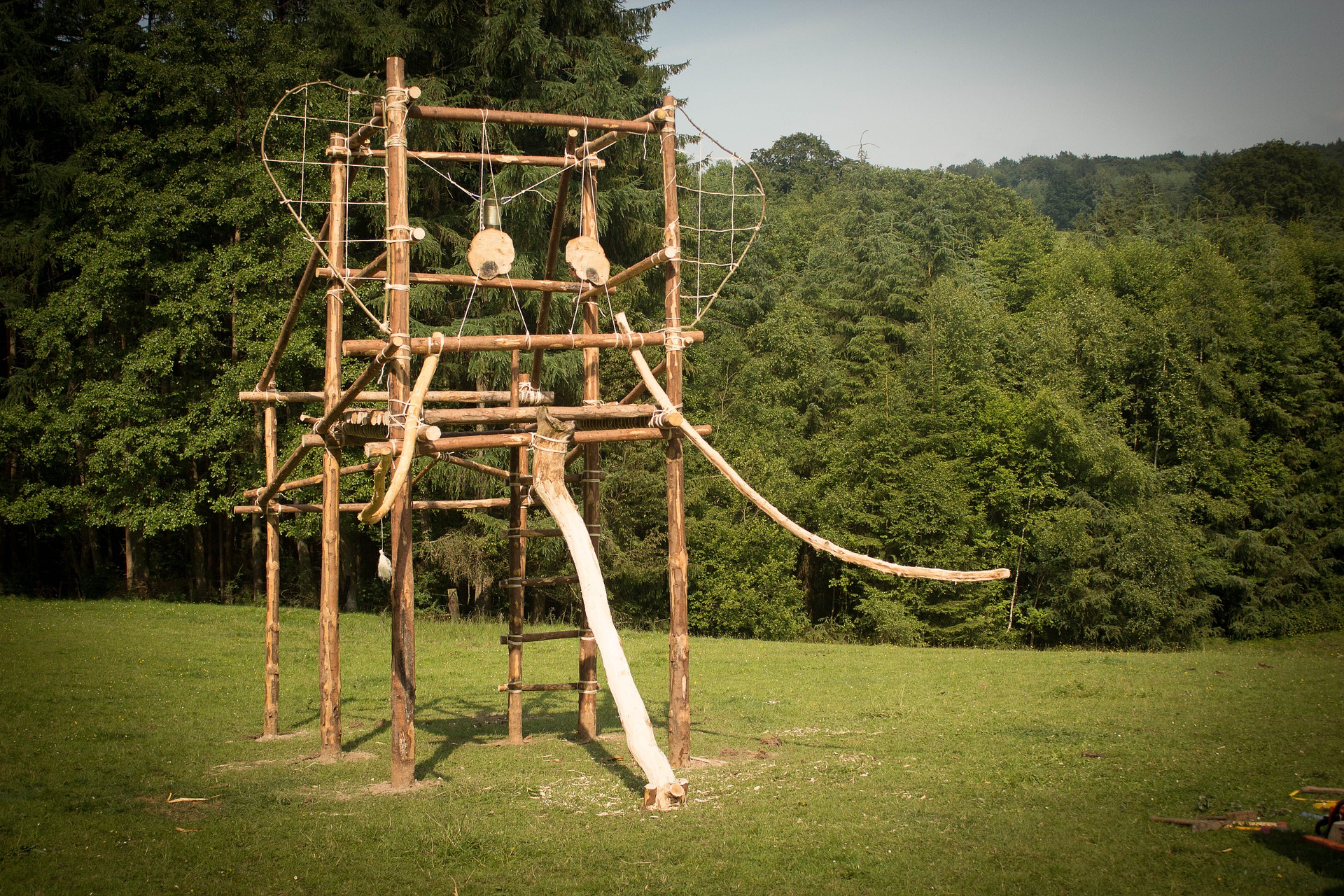
Another traditional Scouting activity, this is based on how an army would move itself across the terrain. One hundred years ago there was no easy way to get across a raging river, or build a defensive wall; the engineers would construct bridges, walls and walkways from what they had to hand – mainly wood and cord. Today we practise building great structures out of staves and wooden poles, using rope to lash them together. We’ve made aerial runways, bridges, roundabouts, swinging logs, and many more fun constructions. Rafting is also a close relative to pioneering, where we create rafts from wooden spars, barrels, and rope, before throwing ourselves on to the water to test them out.
We have a number of leaders at 1st Clayton-le-Moors who are experts at pioneering and knotwork, and we have dedicated material which we often use for this activity.
Knots and Lashings
Typically a Cub Scout should be able to tie around six different knots and lashings. This expands to around twelve for Scouts, and if you are interested in learning more advanced knots (or if you do a lot of climbing or sailing), there are dozens you might learn. Below are twelve of the common knots and lashings that Scouts should learn. Credit to the respective authors.
Click on these names to go straight to the chapter:
- Reef Knot
- Clove Hitch
- Sheet Bend
- Figure of Eight Knot
- Bowline
- Timber Hitch
- Round Turn and Two Half Hitches
- Square Lashing
- Shear Lashing
- Tripod Lashing
- Diagonal Lashing
- Truckers Hitch
Definitions
Firstly, a little info about the names of knots:
Knot
A Knot is a self-contained arrangement of a rope in a particular pattern. It doesn’t need another object, such as a spar or another rope, to keep it’s shape when it is tied. Knot is often used as a generic term for tying any knot, hitch, bend or lashing, but technically only the Knot is a knot.
Hitch
A Hitch is a way of fastening a rope to another object, for example a ring, spar, post, or even another rope (but loosely, so it can move along it).
Bend
A Bend is a way of tying one rope to another (or two ends of one rope together). A Reef Knot is technically a Bend, as is a Sheet Bend.
Lashing
A Lashing is an arrangement of the rope used to secure two or more items together rigidly. Square, Diagonal, Shear and Tripod Lashings are common Scouting Lashings, used to fasten spars together in different arrangements.
Reef Knot (or Square Knot)
The first knot many Cubs, and even Beavers or Squirrels, learn to tie is the Reef Knot. (Technically it isn’t a knot, but a bend, but that doesn’t matter to the kids!) It is used to tie two ropes of equal length together, or to tie two ends of a rope into a loop. It is useful in first aid as a simple knot to tie the ends of a sling together which sits flat behind the shoulder of the casualty. The mantra ‘left over right and under, right over left and under’ is a common one to learn the knot. You must remember to switch hand in between – it is actually the same end which goes over and under, but it is in the other hand after the first pass.
Reef Knots were used in sailing for ‘reefing’ the sails up to the yard to shorten the sail in high winds.
Have a look below to see the knot being tied.
Clove Hitch
The Clove Hitch is a common starter hitch to fix a lashing to a spar. It can be used as part of a Square Lashing, or as part of your safety when climbing or mountaineering. A simple tweak to the Clove Hitch can create the Constrictor Knot, which is much more secure. See the video below to find out how to tie these hitches:
Sheet Bend (and Double Sheet Bend)
A Sheet Bend is a way of joining two unequal thicknesses of rope together. It’s similar to the Reef Knot in style, but tied differently. Adding an extra loop can turn it into a Double Sheet Bend for extra security. Watch below for how to tie it:
Figure of Eight Knot (and Double Figure of Eight)
A Double Figure of Eight Knot is one used often in climbing to securely fasten a safety line to a harness or carabiner. It doesn’t slip or tighten and is easily tied either in the bight or with the end of the line. The single Figure of Eight is tied in the same way, but doesn’t result in a loop. This is used as an easy stopper knot to prevent lines pulling back through other knots. Watch below to find out how to tie it:
Bowline
The Bowline (pronounced bow-linh) is a very useful knot which forms a loop. The loop won’t slip and can be used safely around your waist in an emergency to lower yourself down a cliff, tree or anything else. It can also fasten securely to other items such as trees, without cinching tight against the tree. Take a look at how to tie it here:
Timber Hitch
A Timber Hitch is used for either fixing multiple spares or branches together, or for dragging heavy logs. It is a simple hitch to tie. See how to tie it here:
Round Turn and Two Half Hitches
A Round Turn is simply wrapping a line around a spar once. Adding two Half Hitches to it fixes the Round Turn in place. These are simple hitches, and can be added numerous times for more security and peace of mind. Watch below:
Square Lashing
See the video below to find out how to tie a Square Lashing, which is the most often used lashing when fastening two spars together (at right angles, or square).
Shear Lashing
A Shear Lashing is a way of joining two spars together in line with each other. This could be to create a longer spar, such as for a flagpole. It begins with a Clove Hitch, then wrappings and frappings, and finishes with another Clove Hitch. Watch below:
Tripod Lashing
A Tripod Lashing is a special lashing with one purpose – to create a Tripod from three spars. Just like the other lashings here, it begins and ends with a Clove Hitch, and it involves wrapping the line around the three spars before frapping the joints. Watch this excellent video on how to create a tripod below:
Diagonal Lashing
The Diagonal Lashing is similar to the Square Lashing, but is used when the spars to be fixed together are not at right angles. This lashing will hold the angle that you start with, so take care to hold the spars correctly to start. Again, it begins and ends with a Clove Hitch, and involves wrappings and frappings in the middle. The Clove Hitch can be replaced with a Timber Hitch if preferred. See below for a video on how to tie it:
Truckers Hitch
A Truckers Hitch is a great hitch for putting lots of tension into a line. It is used for securing loads to a truck bed, hence the name, but also for putting up a sturdy washing line or line to hang your tarp from when hammocking. It is easy to take apart afterwards, but it does involve some work.
The Truckers Hitch is tied at the second end of a line, so you’ll want to use another knot to fix the first end. If this is to a tree for a tarp, then a Bowline is probably going to be the best knot at the first end. After that, go to the other end and watch the video below: